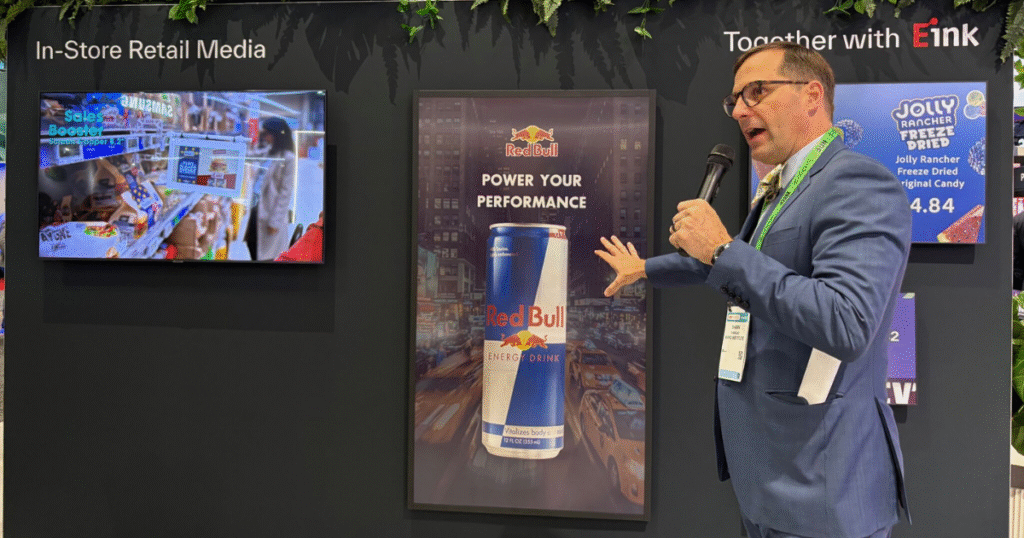

From CES 2026 straight to NRF 2026, one thing became clear. The future of retail is not being reshaped by a single technology. It is being reshaped by how multiple technologies are converging into a new operating model.
Across both events, I had the opportunity to help hundreds of executives explore these shifts through a series of bespoke tours. Think of it as a walking keynote, focused on technologies that are not fully in the market yet, but are close enough to demand strategic attention.
The goal was not to show gadgets. It was to help leaders see how the next phase of retail is taking shape.
TL;DR
- Retail is moving toward agentic commerce and AI-driven decision flows.
- Autonomous vehicles are reshaping curbside delivery and last-mile economics.
- Robotics strategy is becoming a board-level question, not a pilot project.
- Loyalty, data, and experience are converging into a single operating model.
Agentic Commerce Is Moving From Concept to Reality
At NRF, one of the clearest signals was how quickly AI is shifting from recommendation engines to agents that can act.
Retailers are beginning to see commerce as something that happens through delegation, not just browsing. AI agents that can plan, suggest, transact, and follow up are redefining the customer journey.
This changes how discovery works, how loyalty is earned, and how value is captured. The transaction is no longer the center of gravity. The relationship is.
Autonomous Vehicles Are a Retail Economics Story
Autonomous vehicles are often framed as a transportation story. At CES and NRF, they showed up as a retail economics story.
Curbside delivery, last-mile costs, and service reliability are all deeply tied to autonomy. For retailers, the question is not when fully autonomous delivery arrives, but how semi-autonomous systems change cost structures in the near term.
This has direct implications for store formats, fulfillment strategies, and local inventory decisions.
Why Retailers Need a Robotics Strategy Now
Robotics is no longer optional experimentation. It is becoming foundational infrastructure.
From warehouses to stores, robots are moving beyond novelty into core operations. The retailers that benefit most are not the ones testing the most robots. They are the ones defining where robotics fits into their long-term operating model.
A clear robotics strategy forces decisions about labor, layout, throughput, and customer experience. Avoiding those decisions only delays the inevitable tradeoffs.
Loyalty, Data, and Experience Are Merging
One of the most important shifts is how loyalty programs, customer data, and experience design are collapsing into a single system.
Loyalty is no longer about points. It is about recognition. Data is no longer about analytics. It is about orchestration. Experience is no longer about moments. It is about continuity.
Retailers that treat these as separate initiatives will struggle. Those that integrate them will unlock a very different relationship with customers.
Why These Tours Matter
Events like CES and NRF can be overwhelming. The signal is often buried under noise.
The value of a guided experience is not exposure. It is interpretation. Helping executives connect dots across AI, autonomy, robotics, and experience design is what turns trends into strategy.
This is where leaders begin to see how near-term decisions shape long-term advantage.
A Note of Recognition
Before sharing more insights from CES and NRF in the days ahead, it is worth acknowledging the teams that make these experiences meaningful.
The Deloitte teams supporting clients across both events did exceptional work. They helped turn crowded show floors into focused strategic conversations, and they made complex technologies understandable, relevant, and actionable.
That kind of translation is increasingly essential as change accelerates.
Retail is entering a period where its next operating model is being defined in real time. The shifts are not subtle, but they are interconnected.
AI agents, autonomous delivery, robotics, and data-driven loyalty are not separate trends. Together, they are reshaping how retail works.
The next twelve months will matter. The leaders who use this moment to clarify strategy, rather than chase tools, will be the ones setting the pace for what comes next.
If you want, I can also turn this into a shorter executive recap, a visual trend map from CES and NRF, or a forward-looking piece on what retailers should prioritize in the next 90 days.
Related content you might also like:
- From Labs to Living Rooms: The Robotics Sputnik Moment May Have Just Arrived
- The Changing Flow of Video – from the Tablet to the TV
- Keynote: AI and the New Dawn of the Industry
- Agentic AI: Unlocking Organizational Transformation