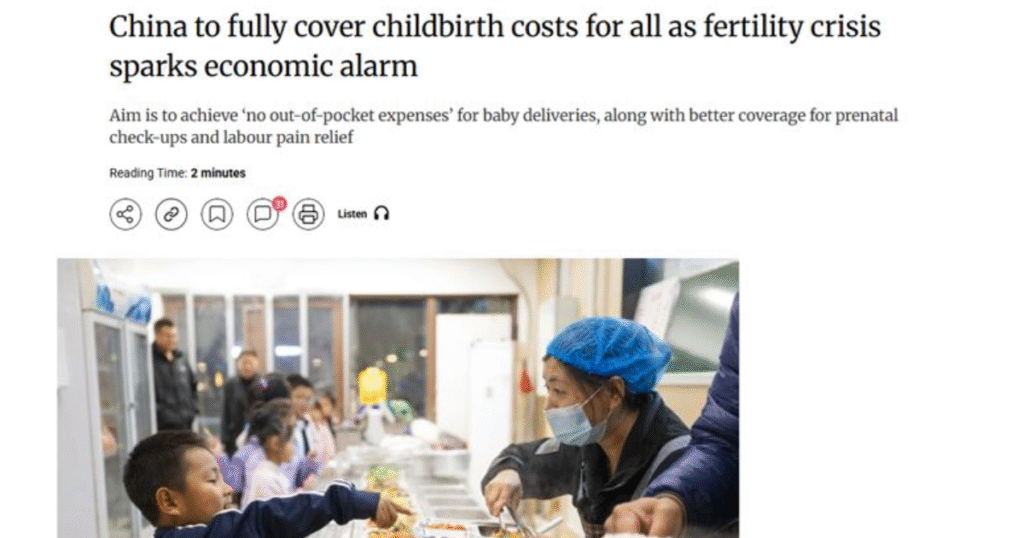

If there was any doubt about whether China is worried about its demographic cliff, that doubt is gone. China’s childbirth subsidies will soon cover all out-of-pocket childbirth costs nationwide.
On the surface, the policy sounds generous. Childbirth can be expensive, and removing that burden may help some families on the margin. But affordability is not the core constraint shaping fertility decisions in China today. The deeper issue is confidence. Confidence in careers. Confidence in housing. Confidence in the future.
This policy is not really about babies. It is about economic confidence and consumption.
TL;DR
- China will fully cover childbirth costs in an effort to raise birth rates.
- The bigger barrier is not cost but confidence in long-term stability.
- The policy is also aimed at boosting household consumption.
- Financial incentives alone struggle to reverse demographic decline.
Why the Cost of China’s Childbirth Subsidies Is Only Part of the Problem
Childbirth expenses are real, but they are a one-time cost. Raising a child is a multi-decade commitment. Decisions about family size depend far more on income stability, job security, housing affordability, education costs, and expectations about the future.
In China, younger households face intense pressure across all of these dimensions. Urban housing remains expensive. Career paths feel less predictable. Economic growth has slowed. The social contract that fueled earlier expansion feels less certain.
Covering childbirth costs addresses a visible expense, but it does not resolve the underlying anxiety shaping family decisions.
The Legacy of Declining Birth Rates
China’s demographic decline did not begin overnight. Birth rates have been falling for decades, shaped by urbanization, rising education levels, delayed marriage, and the long shadow of the one-child policy.
Even after policy restrictions were relaxed, fertility did not rebound meaningfully. This pattern mirrors what has happened across much of East Asia, including South Korea and Japan. Once birth rates fall below replacement, reversing the trend becomes extremely difficult.
The challenge is structural, not transactional.
For context, long-term fertility trends in China are tracked by the World Bank here:
https://data.worldbank.org/indicator/SP.DYN.TFRT.IN?locations=CN
Why the Policy Is Also About Consumption
There is another layer to this decision that matters economically. Households with children spend more. They buy food, clothing, healthcare, education, housing upgrades, and services. A baby increases household consumption across many categories.
From a macroeconomic perspective, boosting birth rates is also a way to support domestic demand at a time when exports and investment face pressure. Encouraging families is indirectly a consumption stimulus.
This helps explain why the policy targets childbirth costs specifically. It lowers the psychological barrier to starting a family and signals state support at a moment of economic uncertainty.
Lessons From Other East Asian Countries
Other governments in the region have tried similar approaches. Cash bonuses, childcare subsidies, tax credits, and parental leave expansions are common tools. The results have been mixed at best.
South Korea has spent hundreds of billions of dollars on pro-natalist policies with limited success. Japan has expanded childcare access and parental benefits without reversing long-term decline.
These cases suggest a hard truth. Financial incentives can help at the margin, but they struggle to overcome deeper structural barriers tied to work culture, housing, gender norms, and long-term economic expectations.
Confidence Is the Binding Constraint in China’s Childbirth Subsidies
Fertility decisions are ultimately forward-looking. People decide to have children when they believe their future will be stable, upward, and predictable enough to support them.
Policies that focus narrowly on cost reduction miss this psychological dimension. Confidence is shaped by labor markets, housing systems, education pathways, and social safety nets. Without progress on those fronts, even generous subsidies may have limited effect.
China’s move signals awareness of the problem, but it also highlights how difficult the solution will be.
What This Means Going Forward for China’s Childbirth Subsidies
The policy should be read as a signal rather than a silver bullet. It shows that demographic decline has become a top-tier economic concern. It also suggests that governments are increasingly willing to intervene directly in family economics.
The open question is whether these interventions can rebuild confidence, or whether they simply soften the edges of a deeper structural shift.
As populations age and birth rates fall, more countries will face the same dilemma. The debate will move from whether to intervene to how deeply systems must change to make families feel secure again.
Conclusion
China’s decision to cover childbirth costs is meaningful, but not for the reasons it first appears. The core issue is not affordability alone. It is confidence in the future.
Demographic policy has become economic policy. And economic confidence, not subsidies, will determine whether birth rates stabilize or continue to fall.
The question facing China and many other societies is whether financial incentives can overcome deeper structural barriers. So far, history suggests that confidence, not cash, is the harder challenge to solve.
Related content you might also like:
- U.S. Demographic Shifts
- A Lack of Confidence Can be Very Contagious
- The Expanding War with China
- Keynote: New World Foundations
- Washington, DC Trip Report: W Hotel + Market Lunch at Eastern Market