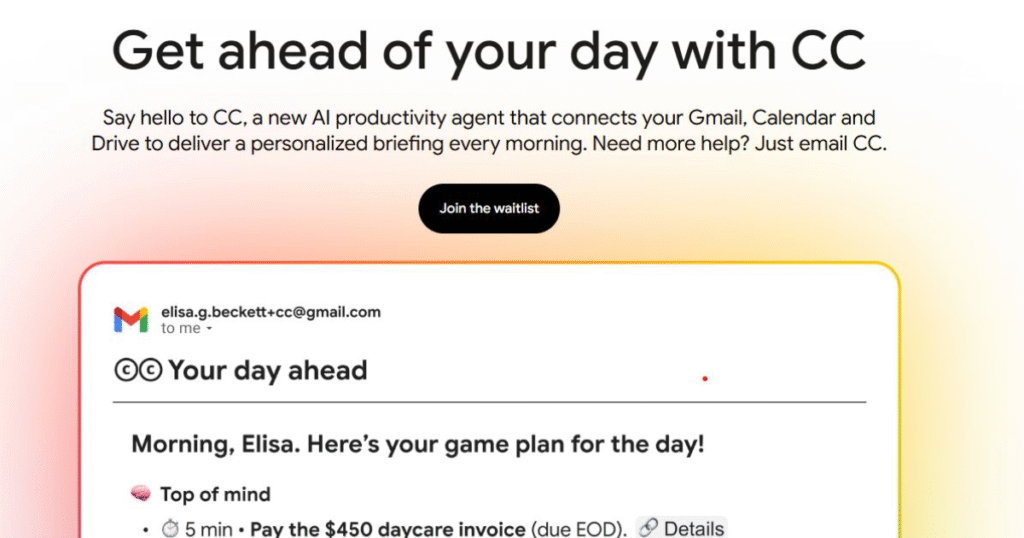

We are going to see an explosion of AI agents in 2026. One early signal arrived quietly this week when Google Labs introduced CC, an experimental AI productivity agent built with Gemini.
At first glance, CC looks like another assistant that summarizes your inbox and calendar. But the more interesting signal is not what it does. It is how you interact with it. You do not open an app. You do not configure dashboards. You email CC directly, the same way you would email another person.
That interaction model changes how work feels. You are not managing software. You are delegating responsibility.
TL;DR
- AI productivity agents are shifting work from tools to delegation.
- Email as an interface makes the agent feel relational, not transactional.
- This signals how AI agents will show up in daily work.
- Productivity is moving from organizing information to deciding what matters next.
Why Email as an Interface Matters for AI Productivity Agents
Most productivity software assumes users want control through menus, settings, and screens. CC flips that assumption. You interact with it through email, one of the oldest and most familiar workplace protocols.
Email turns the agent into something closer to a colleague. You assign tasks. You ask for help. You follow up. The interface disappears into behavior people already understand.
This is subtle but important. When interaction feels natural, delegation becomes normal. And once delegation becomes normal, agents stop feeling experimental.
From Apps to Relationships
The defining shift here is not technical. It is psychological.
Apps require attention. Relationships distribute responsibility.
When you email an agent, you are not just retrieving information. You are trusting it to manage something on your behalf. That trust changes expectations. It also changes how productivity tools are evaluated.
Success is no longer about feature depth. It is about judgment, prioritization, and reliability.
Productivity Has Always Been About What Comes Next
Productivity has never been about doing more. It has always been about deciding what matters next.
Traditional tools help organize information. Task lists, calendars, and dashboards make complexity visible. AI productivity agents take a different approach. They operate in the space between knowing and doing.
They surface priorities. They suggest actions. They reduce the cognitive load of deciding what deserves attention.
That shift makes productivity feel less like management and more like orchestration.
Why This Signals the Era of AI Productivity Agents
Once people get comfortable delegating to agents through natural interactions, the mental model changes. AI stops being something you consult. It becomes something you work with.
This is how the agent era becomes inevitable. Not through dramatic breakthroughs, but through small interface decisions that normalize delegation.
Emailing an agent today looks simple. Tomorrow it becomes routine. Eventually it becomes expected.
What Comes Next for AI Productivity Agents
As these agents mature, several things will matter more than raw capability.
- Judgment over speed
- Trust over novelty
- Context over commands
- Reliability over creativity
The agents that succeed will not be the ones that do the most. They will be the ones that consistently decide well.
That is a very different bar than most software has been held to.
Implications for Leaders and Teams
For organizations, this shift raises new questions.
- Who is allowed to delegate what to an agent
- How are agent decisions reviewed
- What happens when an agent makes a mistake
- How trust is built and measured over time
AI productivity agents will not just change how work gets done. They will change how responsibility is assigned.
That is an organizational design challenge, not just a product one.
Conclusion
Google Labs’ CC is not important because of what it does today. It is important because of how it frames interaction. Email as an interface turns AI from a tool into a participant.
Once delegation becomes the default interaction model, the era of AI productivity agents stops being a concept and starts becoming infrastructure.
Productivity will no longer be about managing information. It will be about managing judgment. And that is where AI agents will reshape daily work in ways we are only beginning to understand.
Related content you might also like:
- AI Agent Classification: How Leaders Should Prepare
- From Assistant to Colleague: The Rise of Autonomous AI Agents
- AI-First Shopping: Walmart + OpenAI Transform eCommerce
- 5 Rules for AI-First Shopping
- Engineering Doesn’t Necessarily Win in the End