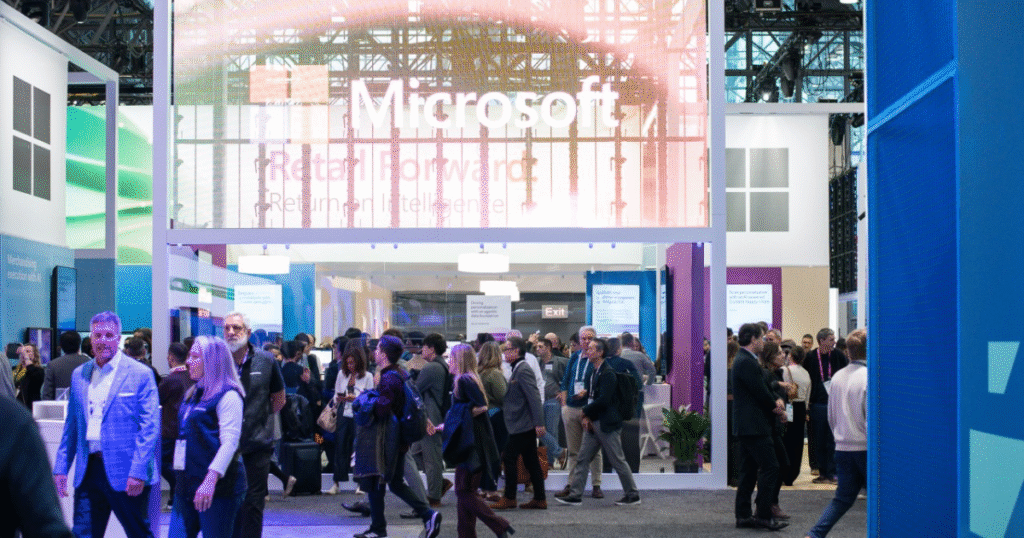

AI was the overarching theme at NRF 2026. Shocker, I know. The same storyline is playing out at nearly every trade show and conference these days. But at NRF, I felt a subtle shift in the conversation. Retailers who have been quietly watching the rapid progression of AI from the sidelines now seem to acknowledge that this is the year to get serious about deployment.
There are a number of reasons for this shift. For one, the cost-benefit equation of AI deployment appears to be improving. The wins seem far less scarce and far less expensive. While AI showed up across nearly every category at NRF 2026, the emphasis is clearly moving from exploration to execution. Many of the use cases were tied directly to core retail functions like merchandising, labor productivity, loss prevention, personalization, and supply chain operations. Compared with earlier waves of AI, there was far less interest in what AI could do for retailers and much more scrutiny on how it performs in real-world environments.
Retailers consistently asked me how these systems will behave at scale (across hundreds of stores in many instances), how they integrate with existing workflows, and where they will deliver measurable impact, either through operational improvement or customer engagement. One of the big shifts I am seeing is a desire to leave the novelty phase of AI behind as we move into 2026. What increasingly matters now is performance in real-world conditions.
In conversations with retail executives, the priority was on deployable AI now. Rather than future-state visions, leaders wanted to understand which AI agents are production-ready, how they function in practice, and what level of oversight they require. We talked a lot about where AI agents will show up on your org chart. The prevailing view was that AI must earn its place by improving execution today, not by promising transformation tomorrow.
There Was a Quiet Friction Between Where Tech Companies Want to Take Agentic Commerce and Where Retailers Will Want to Employ it
There was a quiet but noticeable friction at NRF between where large technology companies want to take agentic commerce and where some retailers are prepared to employ it. Two major announcements underscored this dynamic. Microsoft introduced Copilot Checkout, a new Copilot capability rolling out in the U.S. that lets users browse, get product recommendations, and complete online purchases entirely within the AI chat experience, with integrated payment partners like PayPal, Stripe, and Shopify. Google announced its Universal Commerce Protocol (UPC), an initiative intended to allow merchants to share structured product and availability information with AI agents in a more interoperable way. In different ways, both announcements signal a desire by AI companies to become more deeply embedded across the full commerce journey, not just at discrete touchpoints.
At the same time, retailers expressed caution about how far that embedding should go. AI platform companies are clearly pushing toward agent-led commerce, where AI intermediates discovery, decisioning, and transaction. Retailers, however, are wary of ceding control over customer relationships, proprietary data, and the brand experience itself. While this tension was rarely stated outright, it surfaced repeatedly in side conversations around data ownership, margin compression, and the risk of disintermediation. Retailers were clear that they want agents to enhance their ecosystems by improving service, efficiency, and relevance, not to reduce them to fulfillment layers for someone else’s interface. The goal is differentiation through experience and trust, with AI acting as an enabler rather than a substitute.
Every Retailer Will Work with Agents
It was also clear at NRF that retailers and suppliers will increase the use of AI agents in their own work in the coming years. Widespread, enterprise-wide deployment is still further out, but the range of use cases on display suggests momentum is building and adoption will grow. The near-term emphasis is on internal agents that support core functions across the organization, including store associates, planners, back-of-house operations, marketing teams, and customer service. Many of these use cases are evaluated through a cost-benefit lens, particularly where agents can reduce task load, speed decision-making, and improve consistency without disrupting existing workflows.
At the same time, customer-facing agents are advancing faster than many retailers expected. Google highlighted its work with Papa Johns, while Salesforce pointed to its collaboration with Pandora to create more personalized digital consumer experiences. These examples illustrate how agents are beginning to influence discovery, engagement, and service interactions at the edge of the customer relationship. For now, retailers are prioritizing agents that reduce friction rather than fully automate decisions. However, there was a clear signal that agent-to-agent handoffs, where systems pass information forward to keep work moving, will increasingly be viewed as a viable near-term opportunity rather than a distant concept.
Now is the Time for Retailers to Set Their Robotic Strategy
Robotics discussions at NRF were notably more pragmatic than in prior years. While the momentum around robotics was more pronounced at CES than at NRF, the underlying trajectory is still clear. Retailers are moving beyond curiosity and experimentation toward a more grounded assessment of where robotics can deliver near-term operational value and how those technologies fit within existing store and supply chain environments.
The most common focus areas included inventory scanning, shelf compliance, micro-fulfillment, cleaning, and security. These use cases reflect retailer priorities around labor efficiency, shrink reduction, and execution consistency rather than transformational automation. The emphasis was on reliability, ease of deployment, and integration with current processes, not on fully autonomous or highly complex systems.
Retailers were largely reactive when generative AI emerged in 2022, and there was broad recognition at NRF that repeating that pattern with robotics would be costly. As a result, many organizations are beginning to ask more strategic questions around buy-versus-build decisions, partner selection, operating model integration, and the role of robotics-as-a-service. The conversation is starting to move away from isolated pilots and toward longer-term workforce planning and cost structure design, with the expectation that this transition will accelerate over the next several years. As a result, it is reasonable to expect a significantly larger robotics presence at NRF by 2027.
The Aggregation of Incremental Productivity Gains
One of the clearest themes at NRF was that no single technology promised a step-change improvement in productivity on its own. Instead, the value proposition increasingly comes from the aggregation of small, incremental efficiency gains across multiple parts of the operation. Think improvements in labor scheduling, task management, shrink reduction, demand forecasting, and in-store execution, often enabled by a combination of in-store technology, computer vision, and AI-driven analytics. Individually, these gains may appear modest, but when stacked together they create meaningful operational leverage.
This shift reflects a broader change in how retailers are thinking about transformation. Rather than pursuing moonshot initiatives, many are prioritizing cumulative productivity improvements that can be measured, repeated, and scaled. The focus is on reliability and return, not experimentation for its own sake. This approach also mirrors a more disciplined investment environment, where capital is allocated toward solutions that deliver steady performance improvements and fit within existing operating models.
Retailers Are Selling Attention
Another important theme was the growing recognition that retailers are not just selling products, they are selling attention. In an environment defined by attention scarcity, retailers control valuable moments when consumers are actively engaged and prepared to transact. That position gives retailers increasing leverage, particularly as brands and partners look for more effective ways to reach customers closer to the point of decision.
Retail media networks continue to expand, but NRF conversations placed greater emphasis on attention beyond traditional digital placements. In-store, on-site, and post-purchase moments are becoming central to how retailers think about monetization. AI is accelerating this shift by enabling more precise personalization, dynamic content, and real-time offers tied to context and behavior. The strategic challenge for retailers is balancing the monetization of attention with customer trust and experience, ensuring that increased commercialization enhances relevance rather than creating friction.
The takeaway from NRF 2026 is not that AI is everywhere, but that patience for underperforming technology is disappearing. Retailers are demanding systems that work at scale, integrate cleanly, and improve execution today.
Another takeaway is that the technologies themselves are only part of the change. The second-order effects, how consumer expectations and behaviors shift because of these technologies, will ultimately be much larger and more impactful for retailers. AI, agents, and automation will help get retailers part of the way there, but the more profound shift will come from how customers recalibrate their sense of convenience, speed, personalization, and trust. Preparing for that change requires more than technology investment. It demands a cultural shift inside organizations, one that rethinks what first-in-class looks like in an AI-mediated retail experience.
Related content you might also like:
- Retail’s Next Operating Model Is Coming Into Focus
- The Next Now Defines Retail’s New Operating Condition
- Walmart AI Strategy 2025: Operational Lessons
- Trends from BlackFriday, CyberMonday, and the Reshaping of Retail
- 5 Rules for AI-First Shopping